Heritage hotels and historic neighbourhoods in Ho Chi Minh City
Ho Chi Minh City’s heritage is best experienced as a set of connected places: long-established hotels on Đồng Khởi, civic landmarks nearby, and the distinct streets and religious sites of Chợ Lớn.
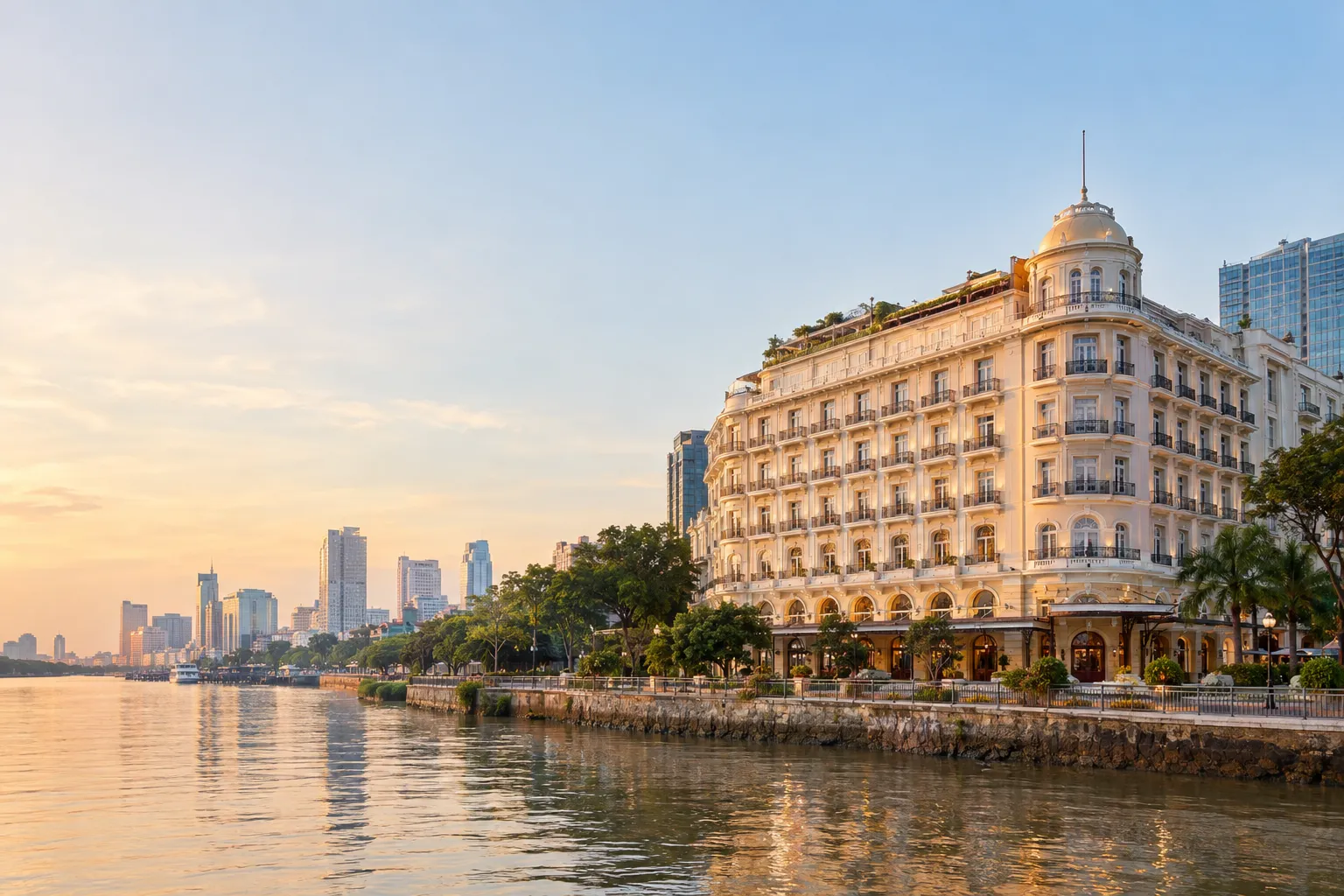
The short answer
Hotel Continental Saigon’s official history dates its inauguration to 1880; Hotel Majestic Saigon’s history dates its establishment to 1925.
Both hotels connect visitors to the central historic area, particularly Đồng Khởi and nearby civic landmarks, while the Majestic also faces the Saigon River setting at Tôn Đức Thắng and Đồng Khởi. A separate visit to Chợ Lớn reveals another kind of neighbourhood heritage through lanes, pagodas and markets.
- Hotel Continental Saigon inaugurated
- 1880
- Hotel Majestic Saigon established
- 1925
- Central street connecting hotel and landmark history
- Đồng Khởi
- Historic quarter distinct from the central district
- Chợ Lớn
A considered guide to Ho Chi Minh City’s heritage hotels and historic districts
The historic centre is walkable in concept, but its heritage is not a single, neatly preserved quarter. It stretches from long-established hotels on Đồng Khởi to the riverfront and outward to Chợ Lớn. Keep the itinerary spacious: start with a hotel’s documented story, connect it to nearby civic architecture, then set aside a separate visit for the city’s distinct neighbourhood cultures.
A city best understood through its layers
Ho Chi Minh City’s heritage is not confined to one preserved quarter. It appears in landmark hotels on Đồng Khởi, civic buildings and cultural institutions in the centre, and the religious and commercial fabric of Chợ Lớn. The city’s former name, Saigon, remains part of how many historic places are described, while contemporary Ho Chi Minh City continues to grow around them. For a visitor, the most rewarding approach is to read these settings together rather than treat a hotel as an isolated monument.
A heritage hotel can provide an architectural point of departure: a building with a documented history, an established place in the city’s streetscape, and a relationship to the neighbourhood outside its doors. Hotel Continental Saigon and Hotel Majestic Saigon make that connection particularly visible. Both sit in the central area, but their histories and locations suggest different ways to encounter the city: one close to civic and cultural landmarks along Đồng Khởi, the other facing the river at the meeting of Đồng Khởi and Tôn Đức Thắng.
This is an editorial guide, not a catalogue of current room features or availability. Hotel details, access arrangements and attraction opening information can change. Use the hotels’ own information for present-day arrangements, and check official city tourism resources before setting out. The lasting value of these places lies in their relationship to the city: architecture is most legible when seen alongside streets, public buildings and everyday neighbourhood life.
Hotel Continental Saigon and the Đồng Khởi setting
Hotel Continental Saigon’s official account dates its inauguration to 1880. It places the hotel on Đồng Khởi, a street whose names changed over time, and describes a setting associated with the Opera House, Notre-Dame Cathedral, the Central Post Office and the People’s Committee building. That location makes the hotel part of a wider urban composition: a central boulevard, civic landmarks and cultural architecture within a compact area.
The story of a long-established hotel is also a story of continuity and change. A building may retain a recognizable historic presence while its surrounding city changes in use, population and pace. The useful question is not whether a visitor can reconstruct an earlier Saigon, but how the surviving architecture helps explain the city’s many periods. Street names, façades and public institutions all offer evidence, though they should not be mistaken for a complete account of local history.
The Continental is therefore a strong anchor for a walk rather than a reason to remain indoors. From the central streets, visitors can connect hotel history to civic architecture and to the public spaces around Nguyễn Huệ. Look carefully at the transitions between buildings: the historic city is not a single period preserved intact, but a sequence of structures and uses that now coexist. For deeper historical interpretation, pair the walk with a museum visit and consult current official information for opening arrangements.
Hotel Majestic Saigon: history at the river’s edge
Hotel Majestic Saigon’s official history says the hotel was established in 1925. Its own materials describe French-colonial architecture and a riverside address at the junction of Đồng Khởi and Tôn Đức Thắng. The setting gives the building a different relationship to the city from a hotel embedded in the busier central streets: here, the river edge becomes part of the heritage experience.
A riverside location also encourages a broader reading of Ho Chi Minh City. The river is not simply a view behind the hotel; it is a reminder that the city’s development has been tied to water, commerce and movement. The Majestic’s documented history and position provide a tangible starting point, while the streets leading back toward Đồng Khởi link it to the city’s central architectural landmarks.
When choosing a historic hotel, distinguish documented heritage from assumptions about a stay. The hotel’s history and architectural character are supported by its official sources; particular room details, services, views or access conditions should be checked directly with the property. Consider what kind of neighbourhood experience matters most: a direct connection to the central civic landmarks, a river-facing urban edge, or a base that makes it easier to devote time to a district such as Chợ Lớn. The right choice is a matter of itinerary and atmosphere, not a universal ranking.
Walking the historic centre: from Đồng Khởi to Nguyễn Huệ
The central historic area rewards a walk with a clear sequence. Vietnam’s official tourism guide points to Đồng Khởi and the nearby Notre-Dame Cathedral, Central Post Office and Opera House. Its suggested city itinerary groups several of these landmarks with the Reunification Palace as historic highlights. Rather than rushing between façades for photographs, allow time to notice how institutional buildings, streets and public spaces relate to one another.
A practical route can begin around Đồng Khởi, taking in the historic hotel context before continuing toward the cultural and civic landmarks identified by official tourism guidance. Nguyễn Huệ offers another perspective on the central city, including former residential buildings now used as shops. This contrast is instructive: heritage is not only a collection of officially prominent monuments but also the reuse of familiar building types in contemporary city life.
Walking conditions vary with heat, rain, traffic and the demands of crossing busy streets. Keep the day flexible, carry water, and pause indoors when needed. Do not assume that every building is open for interior visits or that the exterior is accessible from every approach. Confirm current access and opening arrangements through the relevant official venue channels before planning a tightly timed day. If your stay includes several stops or needs to accommodate luggage and mobility considerations, arrange transport appropriate to your itinerary; UK Direct Chauffeurs offers pre-booked chauffeur transport in London and the UK, but the company’s confirmed service information does not establish service availability in Ho Chi Minh City.
Chợ Lớn: a different register of historic city life
Chợ Lớn, the city’s historic Chinese quarter, offers a distinct complement to the central hotel district. Vietnam Tourism describes exploring its alleyways on foot, visiting pagodas and browsing markets. Its guide names Hào Sỹ Phường alley, Thiên Hậu Pagoda and Bình Tây Market as points of interest. These are not interchangeable with the central city’s boulevard architecture: they invite attention to a neighbourhood’s street life, religious sites and commercial rhythms.
The change of scale is part of the experience. In the centre, landmark buildings and broad streets may organize a visitor’s mental map. In Chợ Lớn, smaller passages and the relationship between market, temple and everyday activity become more prominent. Approach the district with curiosity rather than an expectation that every stop will function as a formal attraction. Observe local customs, be considerate when visiting religious spaces and avoid interrupting residents or worshippers for photographs.
A visit to Chợ Lớn works best when it has enough time to remain unhurried. Check current travel guidance and local conditions before departing, and verify any venue-specific opening information independently. The official tourism material supports a walking-oriented exploration, but it does not guarantee that every site will be open at a particular time. For visitors staying in the central area, the district is a separate outing rather than a small detour between nearby landmarks.
How to read heritage beyond the façade
Heritage hotels and neighbourhoods gain meaning through context. A hotel’s establishment date tells only part of its story; its position on a street, its proximity to civic landmarks and its relationship to later city development help make the history visible. The Continental’s account connects its Đồng Khởi setting to nearby landmarks, while the Majestic’s history and riverside address place it at another threshold between central streets and the water.
For a visitor, this suggests a measured way of looking. Compare the buildings’ settings rather than trying to rank them. Notice how hotel architecture meets the street, how the route changes between Đồng Khởi and the river, and how the central area’s civic landmarks occupy the same broad urban field. Then set those impressions against Chợ Lớn, where the city’s heritage is encountered through a different mixture of lanes, religious sites and markets.
No single walk explains the whole city, and a historic building should not be treated as a substitute for local voices or a full history. Use official hotel histories for the properties’ own timelines, national tourism sources for visitor context, and city tourism information for current planning. Where accounts differ in detail or emphasis, retain the distinction between a hotel’s self-described heritage and wider historical interpretation. This careful approach makes the experience richer without turning a complex city into a postcard of one era.
Ways to explore Ho Chi Minh City’s historic places
The best itinerary depends on the time available and on whether you want to focus on central architecture, neighbourhood life or both. These approaches are grounded in official tourism guidance, but current access and venue conditions should always be checked.
For a first visit: build a central-city walk
A short central-city visit can focus on Đồng Khởi and the nearby landmarks named by Vietnam Tourism: the Opera House, Notre-Dame Cathedral and Central Post Office. Add Nguyễn Huệ and the Reunification Palace if time and current access allow. Verify opening arrangements before treating any interior visit as part of the plan.
- Use the hotel’s own history page to understand its documented timeline.
- Walk between central landmarks at a comfortable pace and allow time for pauses.
- Check current official venue information for access and opening details.
For a longer stay: give Chợ Lớn its own day
A longer stay can separate the central architectural walk from a dedicated outing to Chợ Lớn. The contrast helps show that Ho Chi Minh City’s heritage is varied: civic landmarks and historic hotels in the centre, and a neighbourhood experience shaped by lanes, pagodas and market life in Chợ Lớn. Leave room for changing weather and local conditions.
- Treat Chợ Lớn as its own outing rather than a rushed addition.
- Use official visitor guidance to identify sites, then verify current access locally.
- Plan respectfully around religious spaces and active neighbourhood life.
Key facts about Ho Chi Minh City’s heritage hotels and districts
These points provide a factual starting frame for a visit. They are not a guarantee of present-day access, services or operating hours.
1880
Hotel Continental Saigon’s official history dates its inauguration to 1880 and places it on Đồng Khởi.
1925
Hotel Majestic Saigon’s official history says it was established in 1925.
Riverside setting
Hotel Majestic Saigon describes its architectural character as French-colonial and gives its riverside location as the junction of Đồng Khởi and Tôn Đức Thắng.
Two distinct urban experiences
Vietnam Tourism identifies central landmarks including the Opera House, Notre-Dame Cathedral and Central Post Office, and separately recommends exploring Chợ Lớn on foot.
Frequently asked questions about heritage hotels and historic neighbourhoods
The details below distinguish documented hotel histories and official visitor guidance from information that requires a current check.
What is the history of Hotel Majestic Saigon?
The history cited by Hotel Majestic Saigon’s official materials begins in 1925. The hotel’s official pages describe French-colonial architecture and a location at the junction of Đồng Khởi and Tôn Đức Thắng, beside the Saigon River.
How old is Hotel Continental Saigon?
Hotel Continental Saigon’s official history states that the hotel was inaugurated in 1880. Its location on Đồng Khởi places it close to several central civic and cultural landmarks.
Which historic sights are near Đồng Khởi?
Vietnam Tourism identifies the Opera House, Notre-Dame Cathedral and Central Post Office along the central historic walk associated with Đồng Khởi. Check current venue information for access and opening arrangements.
What can visitors explore in Chợ Lớn?
Vietnam Tourism recommends exploring Chợ Lớn on foot and names Hào Sỹ Phường alley, Thiên Hậu Pagoda and Bình Tây Market. Conditions and access can change, so verify details before setting out.
Stay attentive to the city beyond the hotel
Ho Chi Minh City’s heritage is most compelling when historic hotels are understood as part of a wider living landscape: streets, public buildings, river edges and neighbourhoods with their own rhythms.
Let the city’s layers guide the stay
Choose a historic base for its documented story and its relationship to the city around it, not as a shortcut to a single, fixed version of the past. Begin with the central hotels and landmarks, then make space for Chợ Lớn’s different urban texture. Check current venue details before travel and allow the city to set the pace.
A final perspective
For travellers arranging an itinerary from the United Kingdom, UK Direct Chauffeurs provides pre-booked chauffeur transport across London and the UK; its confirmed information does not establish service in Ho Chi Minh City. The essential planning remains local: verify transport and venue arrangements for the destination directly.
heritage hotels and historic neighbourhoods in Ho Chi Minh City FAQs
What is the history of Hotel Majestic Saigon?
The history cited by Hotel Majestic Saigon’s official materials begins in 1925. The hotel’s official pages describe French-colonial architecture and a location at the junction of Đồng Khởi and Tôn Đức Thắng, beside the Saigon River.
How old is Hotel Continental Saigon?
Hotel Continental Saigon’s official history states that the hotel was inaugurated in 1880. Its location on Đồng Khởi places it close to several central civic and cultural landmarks.
Which historic sights are near Đồng Khởi?
Vietnam Tourism identifies the Opera House, Notre-Dame Cathedral and Central Post Office along the central historic walk associated with Đồng Khởi. Check current venue information for access and opening arrangements.
What can visitors explore in Chợ Lớn?
Vietnam Tourism recommends exploring Chợ Lớn on foot and names Hào Sỹ Phường alley, Thiên Hậu Pagoda and Bình Tây Market. Conditions and access can change, so verify details before setting out.
Sources and references
See the city through its historic places
Let the city’s layered history shape your stay: choose a historic base, then leave room to explore beyond the familiar streets. Related information and services: London City Airport Chauffeur Service, City to City Chauffeur, City to City Chauffeur Transfers UK.
Article reviewed and updated October 31, 2026.
UK Direct Chauffeurs