Antiques and collecting culture in Lyon
Lyon’s antiques and collecting culture spans specialist dealers, the wide-ranging Puces du Canal market and museum collections that place objects within artistic and local histories. For visitors, it is an invitation to browse carefully, compare what they see and understand how objects become part of a larger story.
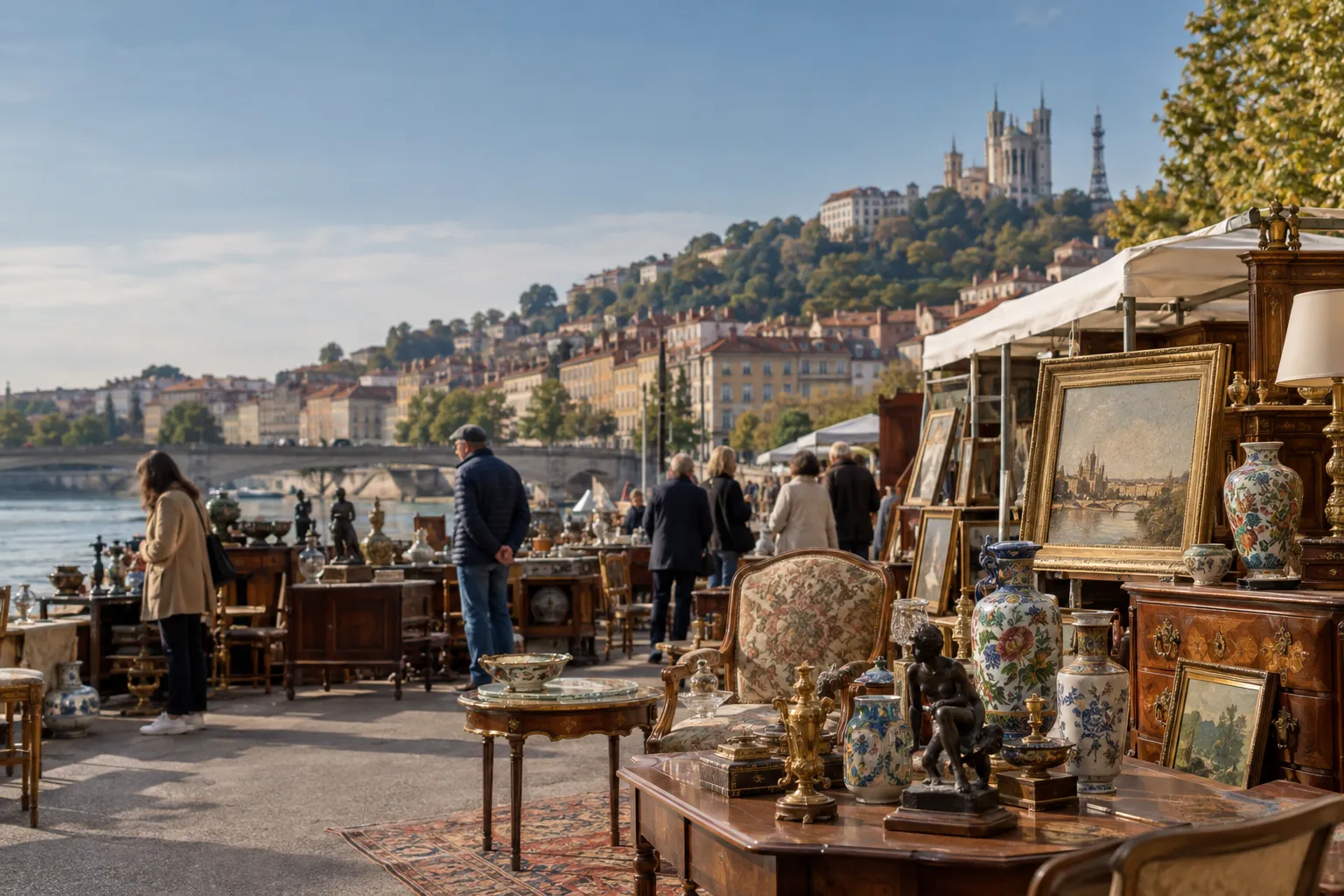
Lyon antiques and collecting at a glance
Start with specialist antiques dealers and galleries on Rue Auguste Comte, or explore the broader antiques, brocante, vintage and design offer at Les Puces du Canal in Villeurbanne.
For context, visit the Musée des Beaux-Arts for antiquities, decorative arts and numismatics, and Gadagne for collections that interpret Lyon’s history. Verify current opening arrangements directly with venues.
- Published visitor address for Les Puces du Canal
- 5 rue Eugène Pottier
- Visitor hours listed in the market FAQ; verify before visiting
- Thursday and Saturday, 7 a.m.–1 p.m.; Sunday, 7 a.m.–3 p.m.
- Coins and medals in the Musée des Beaux-Arts collections
- Almost 50,000
- Collection size stated for the History of Lyon Museum at Gadagne
- 80,000 objects
Antiques and collecting culture in Lyon: a guide to looking closer
In Lyon, collecting has more than one address. The city’s antiques and brocante offer is visible in specialist shops and at the large Puces du Canal market, while museums place objects in artistic, local and historical frameworks. The result is a culture of looking that rewards curiosity as much as acquisition.
A city seen through objects
Lyon’s collecting culture is best understood as a conversation between the objects people seek out and the institutions that preserve them. A visit might begin with the search and surprise of a market, continue through the specialist shops around Rue Auguste Comte, and end in a museum where objects are arranged into a longer account of art, trade and civic life. The city’s surrounding area adds another dimension, from the sprawling Puces du Canal in Villeurbanne to collections devoted to Lyon itself and to the history of transport.
From the market stall to the museum
This is not a single antiques quarter or one neatly bounded scene. It is a set of related practices: browsing, recognising materials and styles, collecting with a particular interest in mind, and learning how museums classify and care for objects. For a visitor, that variety is part of the appeal. A flea-market stall encourages close looking and conversation; a museum offers provenance, comparison and context. Taken together, they make collecting feel less like shopping alone and more like a way of reading the city.
Rue Auguste Comte and the art of specialist browsing
A focused visit begins with a district, not a checklist. Rue Auguste Comte gives visitors an opportunity to explore antiques dealers and galleries in a central Lyon setting, with the freedom to follow their own interests.
Rue Auguste Comte: a specialist browsing district
The official Lyon Tourist Office points visitors to Rue Auguste Comte, south of Place Bellecour, for antiques dealers and galleries. This makes the street a useful starting point for a more considered kind of browsing. Rather than trying to cover every shop, take time to notice how different dealers shape their windows and displays: one may foreground furniture, another decorative objects or works on paper. The neighbourhood setting also makes it possible to combine a gallery visit with a walk through the central city.
- Treat the street as a browsing district rather than a single destination; individual shops have their own specialisms and opening arrangements.
- Look closely at construction, finish, wear and repairs, not only at the overall style of an object.
- If an item interests you, ask the dealer what is known about its age, materials, condition and history. Do not assume that a visual impression is a verified provenance.
How to browse with attention
The pleasure here lies partly in comparison. Seeing objects in several shop windows can sharpen the eye: a change in scale, material or finish becomes easier to recognise when examples sit alongside one another. For collectors, notes and photographs can help distinguish a passing attraction from a sustained interest, although permission should be sought before photographing in shops. For visitors who do not intend to buy, the street still offers a compact introduction to the ways antiques are selected, displayed and interpreted in contemporary Lyon.
Les Puces du Canal: variety, movement and discovery
The Puces du Canal gives Lyon’s antiques culture its most expansive public marketplace expression. It is a place for patient looking, category-hopping and learning through comparison, rather than assuming every visit will produce a particular purchase.
A broad mix of antiques and brocante
Les Puces du Canal, in Villeurbanne, is a different experience in scale and rhythm. Its official visitor information describes a mix of antiques, brocante, vintage and design, with categories including furniture, paintings, books and decorative objects. That breadth means a market visit can be approached as a field of discoveries rather than a hunt for one promised find. The market’s identity rests on variety: domestic objects, older pieces and contemporary interpretations share the same broad browsing environment.
A practical approach to the market
The market’s published visitor address is 5 rue Eugène Pottier, Villeurbanne. Its FAQ lists visitor hours on Thursday and Saturday from 7 a.m. to 1 p.m. and Sunday from 7 a.m. to 3 p.m. Opening arrangements can change, so consult the market’s current official information before setting out. Arriving with time to look, rather than a rigid list of intended purchases, suits a venue where the range of goods is part of the experience.
- Check the official FAQ shortly before visiting for current visitor hours and practical arrangements.
- Decide whether your interest is broad browsing or a particular category, but leave room for unexpected objects.
- For a potential purchase, inspect condition and ask direct questions about repairs, materials and what the seller can substantiate.
- Consider how an object could be transported and cared for before committing to a large or fragile purchase.
The pleasure of discovery, with a collector’s eye
A market is also a place to practise the habits of collecting. Look for the distinction between age, style and condition: an object that looks old is not necessarily antique, and signs of use can be either character or damage depending on the piece. When an item carries significance, ask what documentation or history accompanies it. The most satisfying purchase is not always the rarest; it may be the one whose form, use and condition you can understand and live with.
The Musée des Beaux-Arts: collecting across time
The city’s fine-arts museum makes collecting visible as an act of selection and interpretation. Its holdings provide a deeper historical frame for the objects visitors encounter in shops and markets.
Antiquities and decorative arts at the Musée des Beaux-Arts
Lyon’s museum collections provide a valuable counterpoint to market browsing. The Musée des Beaux-Arts, housed in a former seventeenth-century Benedictine abbey at Place des Terreaux, brings together collections that include Mediterranean antiquities, decorative arts from the sixth to the twentieth century, ceramics, and almost 50,000 coins and medals. These holdings offer several ways to think about collecting: as the preservation of artistic objects, as the study of material culture, and as the ordering of evidence across periods and places.
What museum display adds to collecting
The contrast with a market is instructive. A market places objects in a changing commercial setting, where condition, desirability and price are part of the encounter. A museum makes choices about care, interpretation and relationships between objects. In the Musée des Beaux-Arts, the presence of antiquities alongside decorative arts and numismatic collections widens the frame beyond a single category. It invites visitors to notice how objects can document craft, exchange and cultural contact as well as aesthetic taste.
A more attentive museum visit
The museum’s collections can be explored as a series of distinct fields rather than one uninterrupted survey. Visitors with a particular interest in ancient material, ceramics or coins and medals can use the museum’s current collection information to orient their visit. Check the museum’s official site for current access, displays and visitor arrangements; a collection’s full holdings are not necessarily all on view at one time.
Gadagne and the collections that make Lyon legible
Lyon’s collecting story is not only about objects that cross borders or change hands. It is also about the material record of the city itself, from civic and domestic life to specialist collections that preserve particular histories.
Objects that tell Lyon’s story
Gadagne, in Vieux-Lyon, connects collecting directly to the city’s own history. The Renaissance complex houses the History of Lyon Museum and the Museum of the Arts of the Puppet. The City of Lyon describes the History of Lyon Museum’s collection as comprising 80,000 objects and covering the city’s urban, economic, social, political and cultural history. Here, an object’s interest is not limited to age or appearance: it can help explain how a city was built, worked, governed and experienced.
From personal interest to shared memory
This local focus changes the visitor’s questions. Instead of asking only whether an object is beautiful or unusual, consider what it reveals about everyday life, civic identity or a particular moment in the city’s development. The museum setting makes it easier to connect an individual thing with a wider narrative. It also gives the idea of collecting a civic dimension: preserving objects can preserve traces of communities and ways of life that might otherwise become difficult to see.
A specialised collection beyond the city centre
The Henri Malartre Automobile Museum, in Rochetaillée-sur-Saône, offers another distinct collecting perspective. The City of Lyon describes its holdings as including cars, motorcycles, bicycles, advertising posters and parts associated with collector Henri Malartre. This is a useful reminder that collecting culture is not confined to furniture, paintings or decorative arts. Technical objects can be collected for their design, historical associations and evidence of changing transport and visual culture.
Planning a Lyon collecting day
A collecting-focused visit works best when it has a point of view. A few well-chosen encounters can reveal more than a hurried attempt to cover every market, shop and museum.
- Build the day around a collecting interest
A rewarding day can move between different ways of looking without trying to see everything. Begin with a chosen focus: perhaps decorative objects, local history, works on paper or transport. Browse Rue Auguste Comte if specialist dealers and galleries are the priority, or reserve a separate visit for the Puces du Canal’s wider range. Add a museum visit when you want the historical or artistic context behind a category of objects.
- Choose one main browsing environment for the day: central specialist shops or the Puces du Canal market.
- Pair market looking with a museum whose collections speak to the kinds of objects that caught your attention.
- Allow time for close inspection and breaks; the value of a collecting visit comes from noticing details, not maximising stops.
- Verify current opening arrangements directly with each venue before finalising plans.
- Keep the practical plan grounded
The locations do not form a single compact site, and the Puces du Canal is in Villeurbanne rather than central Lyon. Plan the order of visits around current opening information and your preferred pace. This article does not imply a special access arrangement, guided experience or packaged route. For visitors who need transport between separate locations, UK Direct Chauffeurs is a London-based provider of pre-booked chauffeur transport; its confirmed coverage does not establish a Lyon service, so local arrangements should be checked independently.
- From discovery to considered ownership
Before buying, think beyond the moment of discovery. Check whether an object fits your space, whether its condition is acceptable to you, and whether you can manage its weight, fragility and care. Ask the seller for clear information rather than treating an attractive story as established fact. For higher-value or specialist items, independent expertise may be appropriate. A careful collector is not less romantic; careful attention is what allows an object to remain meaningful after the market visit ends.
Why Lyon invites a slower kind of looking
Lyon’s collecting culture is not defined by acquisition alone. Its lasting interest lies in the movement between encounter and understanding: finding an object, asking what it carries with it, and seeing it in a wider history.
A culture made by looking and remembering
Antiques and collecting culture in Lyon rewards a layered approach. The search begins in a shop or market, where an object is encountered in its material presence: worn, repaired, priced and available for inspection. Museums then widen the frame, showing how objects acquire meaning through preservation, classification and comparison. Lyon’s local-history collections add a further dimension by connecting material things to the city’s own development.
The value of an unfinished search
Whether you come to browse, study or simply understand the city more closely, leave room for questions. What is known about an object, and what remains uncertain? How does its use differ from its display? What does a collection preserve, and what does its arrangement teach? Lyon offers no single answer, but its markets, specialist districts and museums make those questions tangible. That is the enduring pleasure of collecting here: the object may be the beginning, rather than the end, of the story.
antiques and collecting in Lyon FAQs
Where can visitors browse antiques in Lyon?
The Lyon Tourist Office identifies Rue Auguste Comte, south of Place Bellecour, for antiques dealers and galleries. Les Puces du Canal in Villeurbanne is another major destination for antiques, brocante, vintage and design.
What are the published visitor hours for Les Puces du Canal?
The market FAQ lists Thursday and Saturday from 7 a.m. to 1 p.m. and Sunday from 7 a.m. to 3 p.m. Hours may change, so check the official FAQ before visiting.
Which Lyon museums offer a collecting perspective?
The Musée des Beaux-Arts has Mediterranean antiquities, decorative arts, ceramics, and coins and medals. Gadagne’s History of Lyon Museum uses a collection of 80,000 objects to explore the city’s history. The Henri Malartre Automobile Museum presents a specialised collection of transport-related objects.
Is Les Puces du Canal in central Lyon?
No. Its published visitor address is 5 rue Eugène Pottier in Villeurbanne. Check current local travel information when planning a visit.
Sources and references
Look beyond the object
Explore Lyon through the objects it has kept, traded and collected. Related information and services: All Airports We Cover In London, Our Full Chauffeur Services Overview, London City Airport Chauffeur Service.
Article reviewed and updated October 29, 2026.
UK Direct Chauffeurs