Antiques and collecting culture in Ho Chi Minh City
From the shopfronts of Le Cong Kieu to the city’s public museums, Ho Chi Minh City invites a slower kind of looking. This guide explores the context, pleasures and responsibilities of collecting, with practical advice for browsing carefully and interpreting what you see.
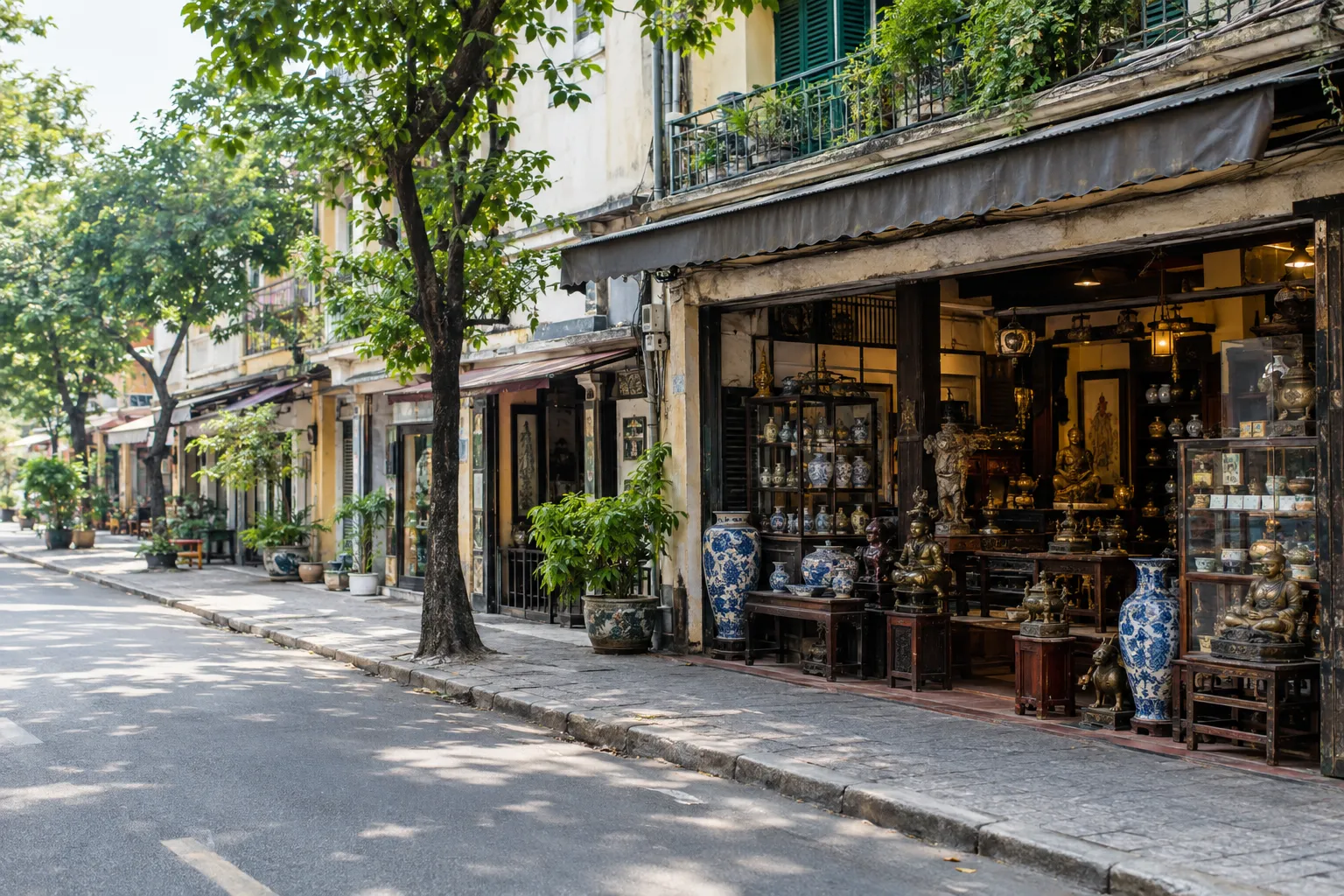
What defines Ho Chi Minh City’s antiques scene?
Le Cong Kieu is the city’s recognised antiques street, offering a concentrated place to browse varied objects.
Public collections at the Museum of Vietnamese History and the Ho Chi Minh City Museum of Fine Arts add historical and artistic context to a visit.
- Le Cong Kieu street length in the city tourism feature
- c. 300 m
- shops described in the same feature
- 40+
- Museum of Vietnamese History founding year
- 1929
- items stated by the Museum of Vietnamese History
- 40,000+
Antiques and collecting culture in Ho Chi Minh City
Ho Chi Minh City’s antiques scene is best approached with curiosity, patience and a willingness to distinguish atmosphere from evidence. Le Cong Kieu offers a concentrated introduction to the trade; the city’s museums provide essential context for thinking about objects, art and the histories they represent.
Antiques and collecting culture in Ho Chi Minh City: reading the city through objects
Ho Chi Minh City’s collecting culture rewards looking twice. An object that first appears to be a decorative find may, on closer inspection, carry traces of several histories: the craft tradition that shaped it, the household or market where it circulated, and the newer meanings assigned to it by dealers, collectors and visitors. This is a city where the pleasures of browsing are inseparable from questions of context. What is old, what is a reproduction, and what can responsibly be taken home are not always obvious from a shop window.
The natural starting point is Le Cong Kieu, a short street in the city centre associated with antique shops and collectible objects. The official Ho Chi Minh City tourism site describes a roughly 300-metre stretch with more than 40 shops, where ceramics, bronze objects, worship items and household goods have been offered. The description is a useful orientation, not a guarantee that every shop or category remains unchanged. A visit is best approached as a slow survey rather than a checklist: notice the variety, ask questions, compare similar pieces and leave room for uncertainty.
The surrounding cultural landscape adds depth. The Museum of Vietnamese History in Ho Chi Minh City and the Ho Chi Minh City Museum of Fine Arts are not antique markets, but their public collections offer different frames for interpreting art and material culture. Together with independent browsing, they make it possible to consider how objects move from use to preservation, from private ownership to public interpretation, and from local memory to a visitor’s curiosity.
How to browse Le Cong Kieu with a collector’s eye
A collector’s first task is not to decide whether an object is beautiful, but to look carefully enough to ask what kind of object it may be. Materials, construction, wear, repairs and signs of use all offer clues, but none is conclusive on its own. A polished surface may be the result of age, restoration or later finishing. A mark or inscription can be meaningful, but it needs interpretation. Even when a seller’s description sounds precise, treat it as a claim to examine rather than independent proof.
On Le Cong Kieu, the range described by the city’s tourism authority suggests how varied a browsing session can be: ceramics, bronze, ritual or worship-related objects, and household items sit within the broad world of collecting. Such categories are not interchangeable. A vessel intended for daily use has a different context from a ceremonial object; a decorative piece may be valued for design rather than age. Learn the vocabulary of the object you are considering, and ask direct, neutral questions about material, origin, age, restoration and previous ownership.
Good looking is active. Compare several examples of the same broad type. Examine the base, joins, edges and underside where possible, while handling objects only with the seller’s permission. Look for inconsistent wear, replaced components, fresh coatings or repairs that affect value. Photographing an item can help with later comparison, but always ask before taking pictures. If the purchase is significant, seek an independent specialist who is qualified in that particular category. General enthusiasm is not a substitute for expertise in ceramics, metalwork, furniture or works on paper.
- Ask what the seller knows about an object’s age, origin, use and ownership history.
- Distinguish an attributed description from documented provenance.
- Inspect condition and repairs, and request permission before handling or photographing.
- Compare similar objects and seek specialist advice before a substantial purchase.
Le Cong Kieu: a street of trade, memory and changing claims
A street associated with antiques is also a place where meanings are negotiated. Dealers choose how to describe stock; buyers bring their own ideas about age, rarity and desirability; visitors may be encountering the objects for the first time. The result is not a single, settled account of the past. It is a living retail setting in which historical references, decorative appeal and commercial judgement overlap.
The official city tourism feature on Le Cong Kieu offers a snapshot of the street as an antiques destination, but its published details should be read with care. It dates from 2021 and gives approximate opening hours of 7 a.m. to 6 p.m. Those figures are historical guidance, not current operating guarantees. Shop stock, individual opening arrangements and the character of a street can change. Plan flexibly, confirm specific destinations where possible and avoid assuming that every address listed in older travel material is still trading in the same way.
For the visitor, the street is most rewarding when treated as a conversation rather than a hunt for a supposedly undiscovered treasure. Ask how a piece is used or understood locally. Listen for uncertainty as well as confidence. A seller who can describe an object’s condition and limitations gives you more to consider than a sweeping claim of rarity. If a price or account seems unclear, pause. The ability to walk away is part of informed collecting, not a failure to find something.
The Museum of Vietnamese History and the public life of collections
Museums provide a useful counterpoint to the market. The Museum of Vietnamese History in Ho Chi Minh City states that it was founded in 1929 and holds more than 40,000 items. Its collections present Vietnamese history and culture through 1945, as well as material relating to southern Vietnam and other Asian cultures. That scale and institutional framing help visitors see how an object can be placed within a wider sequence of historical evidence rather than considered only for its surface or sale price.
The museum’s role is distinct from a dealer’s. A museum collection is assembled, cared for and interpreted for public understanding; a shop presents objects in a commercial setting, where descriptions and ownership histories may vary. Neither setting answers every question. Museum displays can suggest historical context and visual comparison, but a visitor should not assume that an object in a shop is connected to a particular museum artefact, period or culture merely because it looks similar.
The museum’s own visitor-policy page lists admission at 30,000 Vietnamese dong and posted opening times of 8 a.m. to 11.30 a.m. and 1 p.m. to 5 p.m., Tuesday to Sunday, with Monday closed. These are the details published by the institution and should be reconfirmed close to a visit. Treat them as practical planning information, not an assurance that arrangements cannot change. Allow time to read labels and compare objects rather than trying to turn the museum into a hurried pre-purchase authentication exercise.
The Fine Arts Museum: looking beyond age and rarity
Art offers another way into the city’s collecting culture. The Ho Chi Minh City Museum of Fine Arts describes its work as collecting, conserving and exhibiting art, with particular attention to Ho Chi Minh City and southern Vietnam. Its collection is presented across three floors. This institutional focus makes it a natural companion to antique browsing, though the two experiences are different: one is structured around a public collection and its interpretation, the other around individual shops and objects offered for sale.
The museum’s collections page is a reminder that collecting is not confined to antiquities. It also includes the ongoing work of selecting, preserving and presenting art. A visit can sharpen the eye for composition, material and technique, while making clear that an object’s significance does not depend solely on age. The city’s artistic history and contemporary visual culture deserve attention alongside the search for old things.
The museum’s published visitor page gives its address as 97A Pho Duc Chinh Street and states daily hours of 8 a.m. to 5 p.m. Because this information may be revised, check the museum’s own current visitor guidance before setting out. Take the visit at a measured pace: note what catches your attention, read available interpretive material and consider how display choices shape your understanding. The experience is richer when viewed not as a shopping detour, but as a separate cultural encounter.
Planning a considered antiques and museum day
A thoughtful day can connect the street and the museums without pretending that all three are one seamless attraction. Begin with browsing on Le Cong Kieu while attention is fresh; treat shops as individual businesses with their own hours and stock. Continue to a museum only after checking its current visitor information, allowing enough time for the institution’s published schedule and any midday closure. The Museum of Vietnamese History lists a break between morning and afternoon sessions, while the Fine Arts Museum’s published page gives daily hours. Verify both before building an itinerary around them.
The value of this sequence is intellectual as much as practical. The street raises questions: what is this object, how was it used, and what supports the description? A museum visit then broadens the comparison. Public displays can offer cultural and historical context, while reminding the visitor that objects acquire meaning through collection, conservation and interpretation. Returning to the street with those questions in mind can make a second look more discerning.
Do not make a purchase simply because it appears to complete the itinerary. Take notes on the object and the seller’s account, then compare information later. For visitors carrying purchases or moving between multiple stops, UK Direct Chauffeurs provides pre-booked chauffeur transport in London and across the United Kingdom; the company’s confirmed coverage does not establish local transport service in Ho Chi Minh City. In the city, arrange transport through current, locally available options and confirm details independently.
- Check each museum’s official visitor information close to the date of travel.
- Allow for the History Museum’s published morning and afternoon sessions rather than assuming continuous access.
- Keep the market visit flexible because individual shop arrangements may differ.
- Record object details and postpone a major decision if you need independent advice.
Buying thoughtfully in Ho Chi Minh City
The pleasure of finding an object is only one part of collecting. Sound decisions depend on clear questions, measured judgement and respect for the responsibilities that can accompany cultural material.
A careful buyer’s questions: provenance, condition and confidence
Buying an object is different from admiring it. Before negotiating, be clear about what you are purchasing and what the seller’s description actually establishes. Ask whether the object has been repaired, restored or altered, and whether any provenance records exist. If documents are offered, check what they relate to and whether they can be independently assessed. A verbal account may be useful, but it is not equivalent to a documented chain of ownership.
Condition should be considered in relation to the object and your purpose. A collector may accept visible wear as part of an object’s history; another may want an example in a different condition. Repairs can be stabilising or substantially affect interpretation and value. Avoid judging solely by a pleasing patina, which can be difficult to interpret without category-specific knowledge. For higher-value purchases, obtain independent advice before committing.
Practical questions matter too. Clarify the agreed price, payment method, packaging and what happens if you discover a problem. Do not assume that a shop’s use of words such as “antique,” “original” or “old” carries a standard guarantee. If you cannot establish the information you need, declining the purchase is a sensible outcome. Collecting is a long practice of learning; there is no obligation to bring home an object from every visit.
- Confirm the item’s description, condition, restoration and any available provenance.
- Ask what supporting documentation covers and whether it can be independently verified.
- Consider packaging and transport before completing a purchase.
- Pause or seek specialist advice if the claim, condition or terms remain unclear.
Cultural responsibility and taking objects across borders
Objects that cross borders raise questions beyond price and authenticity. Rules can apply to cultural property, antiquities, artworks and materials derived from protected species, and the relevant requirements depend on the object and the jurisdictions involved. Do not assume that a shop receipt alone resolves export or import questions. Nor should a seller’s reassurance be treated as a formal legal determination.
Before buying something that appears old, culturally significant or difficult to classify, identify the object as precisely as possible and seek authoritative advice on whether it may be exported from Vietnam and imported into your destination country. Keep invoices and any provenance documents, but understand that paperwork may need to meet specific requirements. If the object’s status is uncertain, do not proceed until you have reliable guidance. This is especially important for items that may be archaeological, religious, materially restricted or connected to protected wildlife.
The most responsible souvenir may be a photograph, a museum visit or a conversation rather than an object. That choice does not diminish the pleasure of collecting. It recognises that cultural heritage has obligations attached to it and that a visitor may not have enough information to resolve those obligations at the counter. A considered purchase is one that can be explained, documented and transported lawfully, not merely one that fits in a suitcase.
- Check applicable Vietnamese export rules and destination-country import requirements before purchasing.
- Seek authoritative guidance for objects of uncertain age, cultural status or material.
- Keep transaction and provenance documents, without assuming they guarantee permission to export.
- Do not buy if the object’s legal status cannot be established.
A considered conclusion to Ho Chi Minh City’s collecting culture
The most valuable result of an antiques visit may be a better question, not a purchase. A measured approach preserves the pleasure of discovery while respecting the limits of what can be known from a brief encounter.
Etiquette and practical habits for antique browsing
A useful visit leaves space for attention. Begin with one or two categories that genuinely interest you, rather than trying to understand every object in a single afternoon. Ceramics, metalwork, domestic objects and art each require different kinds of knowledge. Keep a small record of what you see: material, dimensions if available, condition, seller’s account and questions you still need answered. Notes make comparison possible and reduce the pressure to decide in the moment.
Approach conversation with respect. A question about use or origin is more useful than an accusation about authenticity. If language makes detailed discussion difficult, keep questions simple and use a translation tool carefully; do not mistake a quick translation for a specialist appraisal. Ask before touching, photographing or moving an object. Some pieces may be fragile, and a shop’s display is not permission to handle everything.
Finally, make room for uncertainty. A good collecting practice does not require a confident conclusion about every object. It can mean recognising an appealing design while remaining unsure of its date, or understanding that an item is suitable as decoration but not as a historically verified acquisition. That distinction protects both enjoyment and judgement.
- Choose a manageable collecting interest and compare objects within that category.
- Keep written notes and separate the seller’s claims from what you can verify.
- Ask permission before handling or photographing objects.
- Let uncertainty remain when evidence is incomplete.
The lasting pleasure of collecting culture in Ho Chi Minh City
The city’s collecting culture is not simply a story about old things for sale. It is also about how histories are selected, preserved, displayed and interpreted. A shop offers a particular encounter shaped by commerce and the dealer’s knowledge; a museum brings objects into a public framework of collection and conservation. Neither should be treated as a shortcut to the other. Moving between them encourages a more nuanced view of why objects matter.
Le Cong Kieu remains a compelling place to begin because the official tourism account identifies it as a concentrated antiques street. But the most satisfying outcome need not be a purchase. It may be learning how to ask better questions, recognising the limits of a claim, or noticing the difference between an object’s visual appeal and its documented history. A museum visit can deepen that understanding by placing art and material culture within broader collections.
For the traveller, the refined approach is a measured one: verify practical details, look closely, listen carefully and make no decision under pressure. Ho Chi Minh City rewards that kind of attention. Its antiques and collections are not a puzzle to solve in an afternoon, but an invitation to keep looking with greater knowledge.
Key points for antiques and collecting culture in Ho Chi Minh City
A visit works best when curiosity is paired with context and careful verification.
A useful starting point
For a first visit, begin with Le Cong Kieu for browsing, then visit one or both museums after confirming current hours. The street and institutions offer complementary perspectives, not a single combined attraction.
A practical collecting principle
A seller’s description is a claim, not independent authentication. Examine condition, ask about restoration and provenance, compare examples and seek specialist advice for significant purchases.
Antiques and collecting culture in Ho Chi Minh City: an overview
Two short reflections frame the subject: first, how Ho Chi Minh City’s markets and museums offer different ways of reading objects; second, how practical care makes that encounter more informed.
A city of objects and interpretations
Ho Chi Minh City’s antiques scene brings together street-level browsing, private trade and public collections. Le Cong Kieu is the natural point of departure, while the Museum of Vietnamese History and the Ho Chi Minh City Museum of Fine Arts offer distinct institutional perspectives on history, art and material culture. A visitor who moves between these settings can learn to look beyond appearance and ask what evidence supports an object’s description.
The collector’s frame of mind
The best approach is deliberate rather than acquisitive. Confirm museum information directly, treat older shop details as provisional, examine condition and provenance, and seek authoritative guidance before taking a culturally significant object across a border. Curiosity is the beginning of collecting; responsible judgement is what makes the experience worthwhile.
Factual points about Ho Chi Minh City’s antiques and collections
These points are grounded in the cited official tourism and museum pages; check time-sensitive details directly before travel.
Le Cong Kieu
The city tourism authority describes Le Cong Kieu as a roughly 300-metre antiques street with more than 40 shops. The same published feature is dated 2021, so its shop count and opening details should not be treated as current guarantees.
Museum of Vietnamese History
The Museum of Vietnamese History states that it was founded in 1929 and holds more than 40,000 items, including collections presenting Vietnamese history and culture through 1945 and material relating to southern Vietnam and Asia.
Museum of Fine Arts
The Ho Chi Minh City Museum of Fine Arts describes a collecting, conservation and exhibition focus, especially on art from Ho Chi Minh City and southern Vietnam, with collections presented across three floors.
Visitor information
Published visitor pages list schedules and admission details, but these can change. Confirm opening arrangements directly with each institution before making a visit-dependent plan.
antiques in Ho Chi Minh City FAQs
Where should I begin exploring antiques in Ho Chi Minh City?
Le Cong Kieu is the city’s best-known antiques street in the official tourism feature. For broader context, consider the Museum of Vietnamese History and the Ho Chi Minh City Museum of Fine Arts, checking current visitor information before you go.
Can I rely on the age or provenance claimed for an antique?
Not without supporting evidence. Ask about origin, ownership history, repairs and restoration, compare similar objects, and seek independent specialist advice for a significant purchase.
What are the current opening hours for Le Cong Kieu shops?
The official city tourism feature published in 2021 gives approximate hours, but these may no longer be accurate. Shop arrangements can vary, so confirm directly where possible and plan flexibly.
What visitor details are published by the museums?
The Museum of Vietnamese History and the Ho Chi Minh City Museum of Fine Arts publish visitor information on their official pages. Because schedules and admission details may change, check those pages directly before visiting.
Can I take an antique bought in Ho Chi Minh City out of Vietnam?
Requirements depend on the object and the applicable export and import rules. Seek authoritative advice before buying and do not assume a receipt or a seller’s assurance is sufficient.
Sources and references
Look closely, ask carefully
Explore the city’s collections with curiosity and care Related information and services: London City Airport Chauffeur Service, City to City Chauffeur, City to City Chauffeur Transfers UK.
Article reviewed and updated October 21, 2026.
UK Direct Chauffeurs